
The DualTech Challenge Returns
The DualTech Challenge returned for its third iteration at ITEC 2026, marking its return to London and continuing its collaboration with Dstl. In 2024, Dstl set the DualTech Challenge, and since then the Strategic Defence Review (SDR) has increased the focus on the role of Artificial Intelligence (AI) in defence.
Building on Dstl's previous 2024 challenge, the 2026 edition sought to identify how AI can be applied to Defence Learning, with a specific focus on learner-facing applications.
Submissions were assessed by Dstl and Front Line Command Stakeholders. Three finalists were be selected by a Dstl-led judging panel to showcase their innovations live on stage at ITEC 2026.
The winner received a commendation and a complimentary pod at ITEC 2027, offering unparalleled credibility and exposure within the industry.
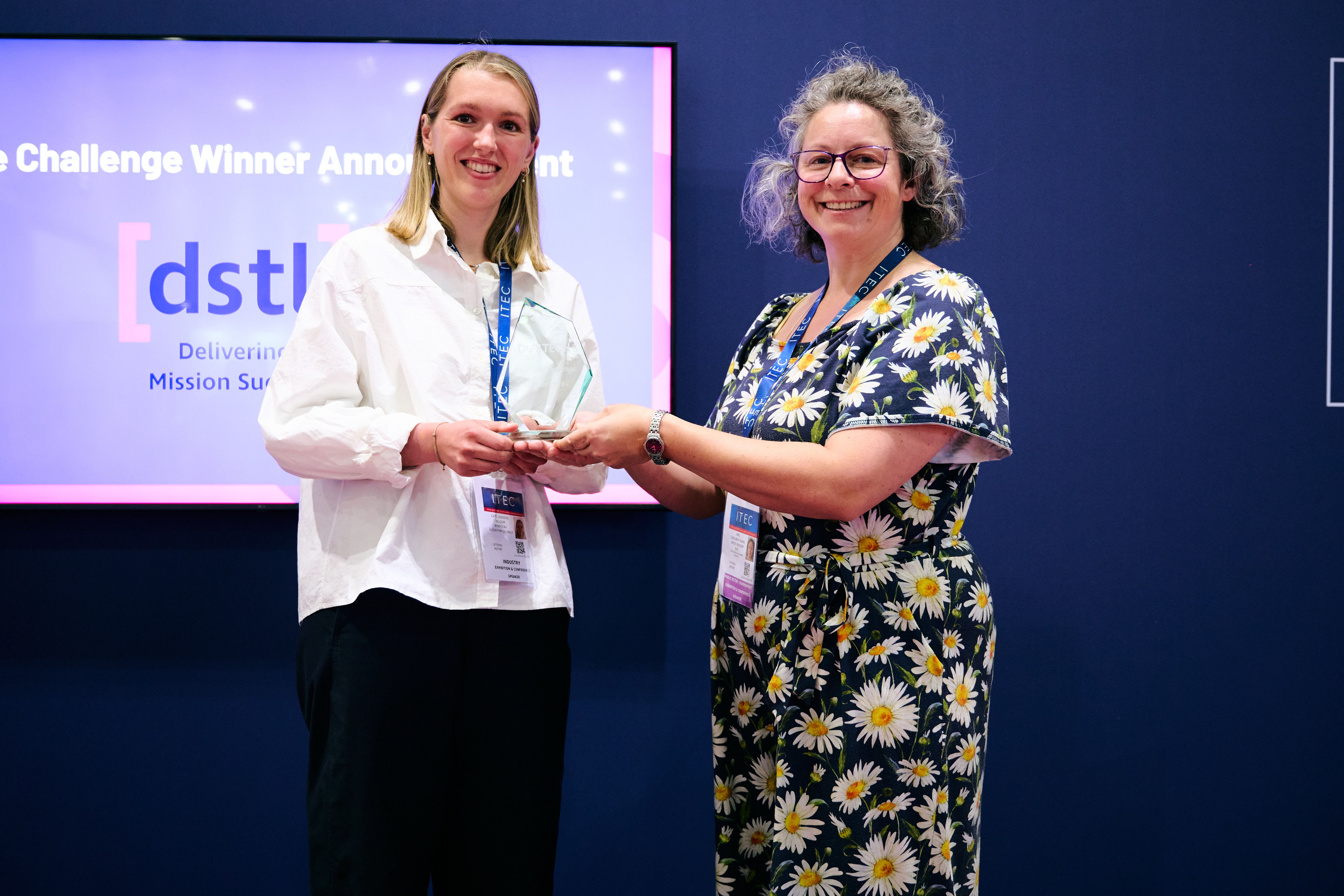
The Challenge Winner 2026
Drs. Cato Leenders is an Algorithm Engineer at BioRICS NV and the winner of the DualTech 2026 Challenge. Her winning submission, “Human‑centric AI for defence learning and performance monitoring: Real‑time neuroplasticity monitoring to improve training performance,” was recognised for its exceptional alignment with Dstl’s human‑centric AI brief. The judges highlighted the strength of the underlying science and the clarity with which her learner‑facing AI approach enhances instructor decision‑making and delivers measurable improvements in training outcomes. This work exemplifies how advanced AI can be responsibly applied to drive real‑world impact in defence learning environments.
The 2026 Finalists
Drs. Cato Leenders, Algorithm Engineer - BioRICS NV
Human centric AI for defence learning and performance monitoring: Real time neuroplasticity monitoring to improve training performance
Modern military learning demands more than knowledge transfer - it requires adaptable, resilient personnel ready to make fast decisions under pressure. This human‑centric AI solution brings validated physiological science into training, using everyday wearables to track cognitive load, stress, fatigue, focus, and readiness in real time.
Instructors gain clear, actionable insights - showing when trainees are primed to learn, when performance is at risk, and when neuroplastic change is happening - enabling smarter adjustments to training tempo and difficulty.
The result: safer, more efficient, more personalised training that accelerates skill development, prevents overload, and strengthens resilience across the force. Science‑driven, explainable, and built around the human - this is the future of defence learning.
Bram Ridder, Technical Director, Intelligent Artefacts
Michael Boniface, CEO, Intelligent Artefacts
Optimising wargaming with human-in-the-middle AI planning
Intelligent Artefacts is redefining wargaming with a human‑in‑the‑middle AI Planning system that builds and adapts scenarios in minutes - not days - while keeping instructors fully in control. Through an intuitive interface, instructors set objectives and constraints, and the AI instantly generates explainable action plans that can be refined on the fly.
Fully transparent, compatible with existing simulation environments, and powered by state‑of‑the‑art planning research, this solution removes technical barriers, accelerates scenario creation, and enables rapid, trusted collaboration between human expertise and AI.
The result: faster setup, smoother adjustments, and more effective, responsive wargaming for modern training needs.
Mr. Rex Kendall, Co-founder and CTO - nordfen
AI Scenario Builder
nordfen turns real‑world terrain into high‑fidelity 3D training environments for drone operators - generated in hours, not weeks. Using real geodata, physics‑accurate flight models, and an adaptive scenario engine, instructors can create and modify missions on the fly without specialist simulation skills.
Operators can train anywhere, anytime, building real spatial awareness in the exact terrain they’ll face on deployment. With detailed telemetry, repeatable scenarios, and scalable oversight for instructors, the platform delivers structured, evidence‑based progression while keeping human judgement at the centre.
The result: accessible, realistic, and responsive simulation that accelerates skill development and transforms drone operator training.
Challenge area: How can AI be used in Defence Learning?
The Challenge looks beyond the transmission of knowledge alone, aiming to understand how defence can further integrate AI into the classroom environment. Submissions are welcomed from academia, SMEs, and research organisations that demonstrate how defence can accelerate its understanding and adoption of AI to enhance learning delivery.
Of particular interest are submissions that consider:
- Human-centric AI solutions
- AI as an extension of human instruction
- Systems that incorporate AI into a wider learning ecosystem
In early 2025 the UK Government published the AI Opportunities Action Plan in which it sets out the ambition to exploit the potential of AI tools and technologies to support the public sector. This aim is also shared by defence who recognise, that there is a strategic requirement to prevent the UK from falling further behind competitors and allies with regards to exploitation of technologies such as AI (MOD, 2022). Their specific priorities are set out in the defence Artificial Intelligence Strategy (2022) and include achieving:
- “Decision Advantage- Increase operational tempo and agility through better-informed and distributed decision-making and machine-speed responses to threats.
- Efficiency- Improve flexibility, productivity and availability through intelligent automation.
- Unlocking New Capabilities- Secure operational advantage by developing novel ways to operate, deliver enhanced military effect and protect our people from harm.
- Empower the Whole Force- Reduce burdens and focus human talents on higher value functions requiring ingenuity, contextual thinking and judgement.
| Collaborating with the challenge through ITEC gave us the opportunity to expose our thinking to the broader community. We could share our research and ensure the industry was positioned to be able to meet the needs of the future. It was helpful to know where industry are focusing their resource efforts currently and identifying where we might need to put more support in to accelerate capabilities if we require them in the future - Caroline Shawl, Principal Technical Authority, Dstl |
The Reward
Each finalist received:
-
Speaking opportunity at the DualTech Theatre and opportunity to demonstrate physical products.
-
Full Speaker registration (including access to the exhibition, main conference and catering)
-
Prolonged exposure on the event website
-
Profile in DualTech Challenge literature/website and DualTech agenda
-
Associated promotion on social media channels
The Grand Prize
The DualTech Challenge winner received a commendation and a complimentary pod at ITEC 2027.
| We got off the stage and we couldn’t thank the organisers because we couldn’t get through - Representative from Mission Decisions (2024 Winner) |